
Short summer seasons teach me some lifelong lessons about living with hEDS
I’ve learned to listen to my body when it tells me I need to rest, eat, and hydrate
Written by |




Summer. A short, but cherished season here in Montana, land of long winters.
As soon as the first warm day arrives and the sun shines brightly over our valleys, majestic mountains, and many lakes, I’m eager to get outside and make memories with my family! But I soon remember that I need to slow my horses and be more intentional with my day before I set foot outside.
Over the last decade, my once highly active, strong body has betrayed me and slowly taken away many of the freedoms I once knew (and took for granted). The body I knew so well and depended on for more than 25 years became this foreign vessel, one plagued by what I now know are triggers and flares from hypermobile Ehlers-Danlos syndrome (hEDS) and a handful of the comorbidities that can go along with this genetic connective tissue disorder.
The diagnosis meant that I can do far fewer activities with my kids, which left me feeling guilty and grieving the loss of the active lifestyle I once knew.
It wasn’t until I got my formal hEDS diagnosis, with comorbidities like postural orthostatic tachycardia syndrome (POTS) and mast cell activation syndrome, that I began to understand what was going on in my body, and what I needed to do to try to feel better.

What I need to do to feel better
What I have learned is that these feelings of grief and guilt are not just my own. Many people in the hEDS community share these same struggles. Feelings of deep loss and frustration when their bodies no longer cooperate, and even guilt for not being able to show up the way they once did. I get it.
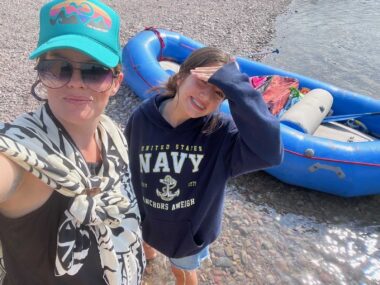
Lacy Rosenbaum and her daughter enjoy a day of boating on the Flathead River on a recent summer day in northern Montana. (Photo by Lacy Rosenbaum)
Living with hEDS and POTS requires constant, exhausting muscle contractions, tensing all of my muscles, to help stabilize my joints and maintain proper blood flow. My muscles and vascular system also require daily complete hydration in the form of mostly mineral sea-salted or electrolyte-packed water. The days of only drinking a glass or two of plain water here and there are long gone — unless I want a full-on functional collapse where I’m laid out in bed with a cool rag over my head, fan blazing while my body spasms and shakes uncontrollably.
These days, I don’t leave home without either a packet of mineral sea salts or a few electrolyte packets, my water canteen, probably a matcha tea (so I can have a little perk of caffeine, but not too much or I’ll crash hard), and a sports drink. I’ve also found that if I’m going to be out for long, I need to practice sun time management. I keep a chair or blanket in my vehicle so I can sit, hopefully in the shade, when my loose joints, poor circulation, and dysregulated nervous system start to give me warning signs, such as dizziness, elevated heart rate, weak leg muscles, and flushing.
I’ve learned to respect and listen to my body when it tells me I need to rest, eat, hydrate, or say no. It’s the only way I’ve been slowly able to put the pieces of my life back together.
I also count my spoons, a helpful strategy of energy conservation I learned a few years ago for managing life with chronic illness. On the day I write this, I know I can probably manage six spoons — one to get ready for the day, one to sit long enough to finish writing this column, two to stand and make meals for my family, and two to go outside in the warm sun, feed my animals, and do minimal-effort farm chores. I want to wash my hair tonight, but I’ll have to reassess my spoons this evening as I can’t afford to push myself. Counting spoons helps me respect my limited energy and avoid borrowing strength from tomorrow and the crashes that would follow.
Small tricks like these have helped my body cooperate and taught me to adjust my plans, as needed, something I never would’ve thought possible just a few short years ago.
Summer is beautiful, and I can’t tell you how grateful I am to be able to start enjoying it with my family again. But slowly.
Note: Ehlers-Danlos News is strictly a news and information website about the disease. It does not provide medical advice, diagnosis, or treatment. This content is not intended to be a substitute for professional medical advice, diagnosis, or treatment. Always seek the advice of your physician or another qualified health provider with any questions you may have regarding a medical condition. Never disregard professional medical advice or delay in seeking it because of something you have read on this website. The opinions expressed in this column are not those of Ehlers-Danlos News or its parent company, Bionews, and are intended to spark discussion about issues pertaining to Ehlers-Danlos.


Val A
Thank you for your article. I can relate! I'm glad you got a diagnosis, it was a struggle where I live, although the disorder wasn't well known when I started deteriorating.
Lacy Rosenbaum
Hi Val, thanks for reading my column! Goodness, I am sorry to hear of your struggles. I hope you're getting the care and support you need now. My heart goes out to you.
I wish you all the best,
Lacy